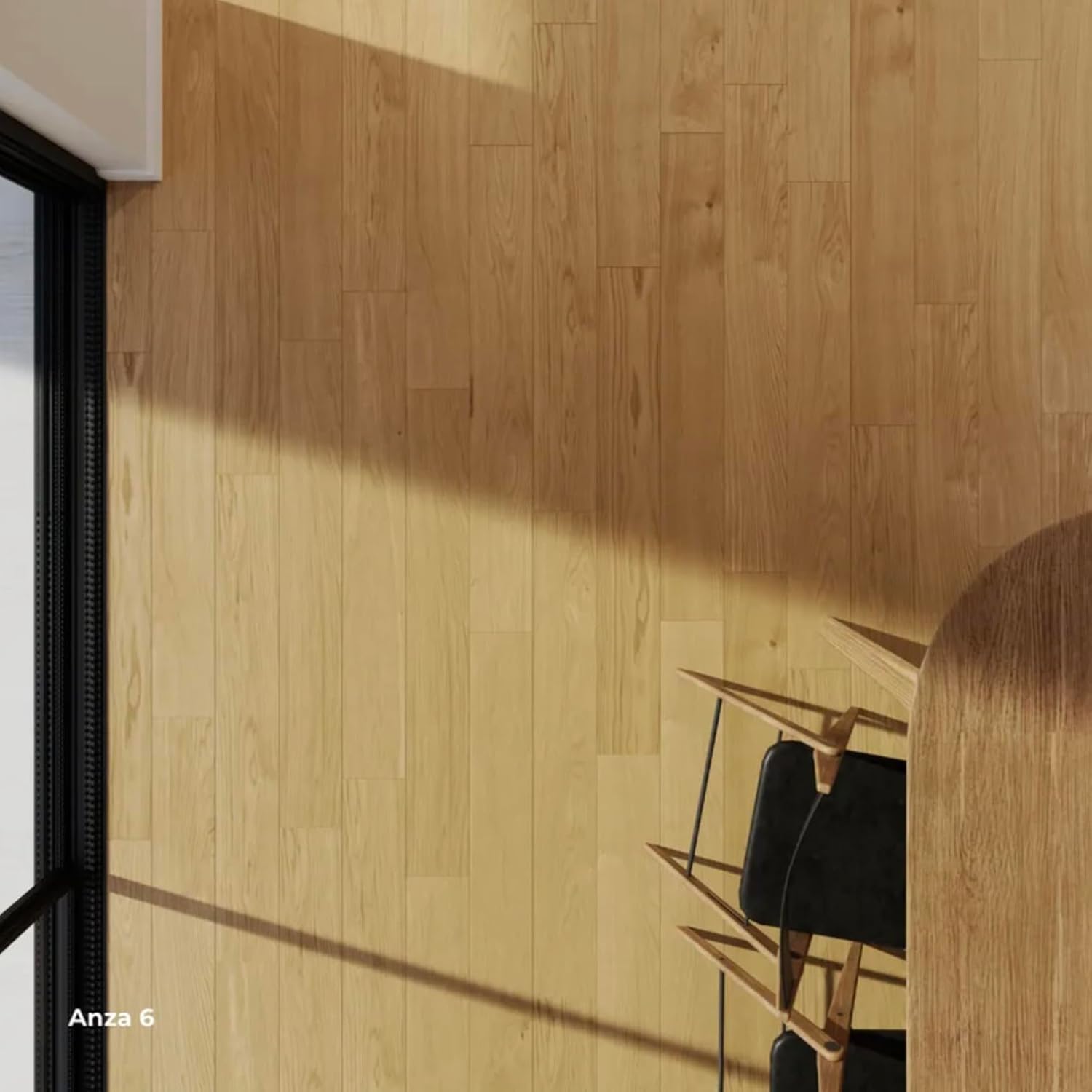
You’re standing in a showroom or scrolling a product page, and you’ve narrowed it down to two or three engineered hardwood floors you like. Engineered hardwood is flooring made from a real wood veneer — the top layer you see and walk on — bonded over a core of layered plywood or composite material. It looks and feels like solid wood but handles humidity and subfloor variation better, which is why it dominates the $2–6 per square foot tier at retailers like Floor & Decor and BuildDirect, and scales up through mid-range and premium lines as well. The catch: what you see on a screen, or even a 3×3-inch chip in a showroom, is almost never what you see covering 600 square feet of your living room floor. This article is a practical checklist — the samples to order, the sequence to test them in, and the decision rules that tell you when you’re actually ready to pull the trigger.
If you’ve already spec’d a floor once and gotten surprised by color shift, gloss variation, or a finish that looked different under your kitchen’s recessed lights than it did in the store, this is the article you needed six months ago. Let’s make sure it doesn’t happen again.
| EDITOR'S PICK[Mohawk Advance Engineered Hardw…](https://www.amazon.com/dp/B0D2M2STFM?tag=greenflower20-20) | Mid-tierAmerican Walnut Select & Better… | Budget pick[Element Flooring (Sample) Napa…](https://www.amazon.com/dp/B0C826471P?tag=greenflower20-20) | |
|---|---|---|---|
| Species | Maple | Walnut | Hickory |
| Style | Hand Scraped | — | — |
| Wear Layer | — | 4mm | — |
| Width | 6.5 in | 5 in | 7.5 in |
| Price | $20.08 | $5.99 | $5.00 |
| See on Amazon → | See on Amazon → | See on Amazon → |
Why Samples Fail Most Buyers (And What to Actually Order)
The default sample most retailers mail you is a single plank — usually four to six inches wide and eight to twelve inches long — chosen from the middle of the grade run. It’s the median board, photographed under controlled studio lighting, sent to your house where nothing about the lighting is controlled.
The problem isn’t the sample itself. The problem is that buyers treat one sample as a verdict instead of as the opening bid in a conversation. Here’s what you should be ordering instead:
1. A full-range “character spread” — minimum three boards
Engineered hardwood, especially at the character and select grades common in the $3–8/sq ft range, has wide board-to-board variation. The National Wood Flooring Association’s installation guidelines note explicitly that flooring should be racked out (laid loosely across the room before nailing) to allow for visual blending — because individual boards can look dramatically different from each other within a single box. Ask the retailer or manufacturer for samples that show the lightest board, the darkest board, and the most knotty or figured board in the run. If they can only send you one, ask which grade extreme it represents.
Lauzon, Mirage, and Carlisle Wide Plank Floors all maintain sample programs that allow character-range requests. For BuildDirect and similar direct-to-consumer importers, the product listing pages often indicate whether character-grade samples are available on request — worth a phone call.
2. The finish chip under your actual light sources
Architectural Digest’s overview of engineered wood flooring flags this consistently: sheen level (matte, satin, semi-gloss) looks completely different under warm incandescent or Edison-style bulbs versus cool LED recessed lighting. A floor marketed as “low-sheen matte” can read as satin under 4000K LEDs. Take your sample and place it on the floor — not on a countertop, not held up to a window — in the room where it will live, under the lights you actually use, at different times of day.
This sounds obvious. Almost nobody does it consistently. Fine Homebuilding’s installation coverage specifically calls out that finish sheen decisions made in showrooms are one of the most common sources of post-install dissatisfaction.
3. A sample of the species or core you’re comparing against
If you’re choosing between maple and white oak at the same price tier, order samples of both at the same time and compare them side by side. Don’t rely on your memory from a store visit two weeks ago. The comparison needs to happen in your space, at your eye level, next to your cabinetry.
This matters especially with maple. Maple is lighter and more uniform-looking than oak, which some rooms love and some rooms fight. It’s also more prone to UV yellowing over time — Bob Vila’s comparative flooring coverage and This Old House both flag this as a known maple trade-off. An oil-rubbed or UV-cured finish slows the shift, but it doesn’t eliminate it. If you’re comparing a light maple to a light white oak and expecting them to age similarly, they won’t. Seeing a UV-aged maple sample alongside a fresh one — some specialty retailers and Lauzon’s showroom reps can provide these — is genuinely useful.
4. A sample with your actual stain or finish applied, if you’re finishing on-site
If you’re purchasing unfinished engineered hardwood and having it stained to match existing millwork or cabinetry, this is the step most buyers skip and most installers wish they hadn’t. Maple is notoriously blotchy when stained — its tight, consistent grain means pigment absorbs unevenly, producing a patchy result that surprises buyers who’ve stained oak or pine without issue.
Per the National Wood Flooring Association’s finishing guidance, maple typically requires a wood conditioner or wash coat before staining to get even color distribution. Have your installer apply your chosen stain to a sample board before the project starts. This isn’t a precaution — it’s a requirement if color consistency matters to you.
The Sample Testing Sequence That Actually Works
Most buyers run samples in parallel and make a gut call. That’s fine if you’re already familiar with a species or a manufacturer’s range. If you’re not, a sequential test protocol will save you money.
Step 1 — Establish your light baseline first. Before any samples arrive, photograph the room in question at three times of day: morning, midday, and evening with your artificial lights on. Note whether the dominant light is warm or cool. This becomes your reference when you’re evaluating how a floor’s color and sheen reads in that room. Apartment Therapy’s flooring guides consistently recommend this step; the editorial consensus is that buyers who skip it overweight how the floor looks in photos versus how it lives.
Step 2 — Eliminate on finish, then species. Start by narrowing sheen level. Matte and satin are objectively different to live with — matte hides micro-scratches and dust better (Fine Homebuilding’s coverage of finish wear notes this), satin reads richer in lower-light rooms. Decide sheen before you decide species or color. Once finish is locked, compare your two or three species candidates.
Step 3 — Put the finalist on the floor for 48 hours. Tape it flat to the subfloor or float it against your baseboard. Walk past it. Look at it from across the room. Look at it when you walk in from outside with adjusted eyes. If you have a partner or a designer involved in the decision, do this before they weigh in — first reactions to a floor already “living” in the space are more reliable than reactions to a sample held in hand.
Step 4 — Check the transition. If you’re replacing flooring in one room or zone that will meet existing flooring, doors, or tile at a transition point, place your sample at that exact junction and evaluate it. Color temperature, thickness, and sheen can all create visual discord at transitions that wasn’t obvious from the sample alone.
By the Numbers: What It Actually Costs to Sample Right
| Sample type | Typical cost | Who typically covers it |
|---|---|---|
| Standard single plank (retailer) | Free–$5 | Retailer ships free or charges nominal shipping |
| Character-spread set (3 boards) | $0–$25 | Varies; Lauzon and Carlisle often complimentary |
| Unfinished board for stain test | $10–$30 | Buyer pays; installer applies stain at quoted rate |
| Return shipping if you reject | $0–$15 | Most direct retailers waive on returns |
The total cost to sample properly: $0–$70. The cost of a wrong floor decision at 600 sq ft and $5/sq ft installed: $3,000 minimum, not counting removal. The math is not close.
When You’re Actually Ready to Commit
Here’s the decision rule, stated plainly:
If you’ve seen the floor on your subfloor, under your lights, next to your cabinets, at both ends of its character range — commit.
If any one of those conditions isn’t met, order one more sample.
The corollary: if you’re comparing two floors that both passed the 48-hour test, go with the one that your installer is more familiar with. Engineered hardwood installation quality is heavily influenced by acclimation time, adhesive choice, and subfloor prep — and those are execution variables, not product variables. An installer who’s laid 20,000 square feet of Lauzon will produce a better result with Lauzon than with a brand they’ve never worked with, even if the competing product specs are equal.
A note on the $2–6 tier specifically: at Floor & Decor and BuildDirect price points, product turnover is faster than at premium brands. A floor that’s in stock today may be discontinued or reformulated in 18 months. If you’re doing a phased renovation — one room now, another later — order and hold enough material from the same dye lot to cover both phases. Dye lot variation (subtle color differences between production runs) is flagged repeatedly in Fine Homebuilding’s installation guidance as a chronic issue at the production-volume end of the market.
Before You Order: Three Questions to Ask the Retailer
-
“Can you send me boards from the low and high end of the character range, not just the median?” If they say no or don’t understand the question, that’s information.
-
“What’s the dye lot situation if I need to order more in six months?” The answer tells you whether you need to overbuy now.
-
“Is the finish factory-applied UV-cured, or site-applied?” UV-cured finishes (standard on Lauzon, Mirage, and most engineered lines) are more consistent than site-applied. If it’s site-applied, see Step 4 in the stain-testing sequence above — it applies to you.
Sampling costs almost nothing and fixes almost every post-install regret. Order the range, test under your lights, check the stain if you’re going custom, and don’t commit until the floor has lived on your actual subfloor for two days. That’s the whole system.
Ready to compare species side by side before you order? Use our [Species Comparison Tool →] to filter maple, white oak, and hickory across finish types and price tiers — then request samples from your shortlist in one step.