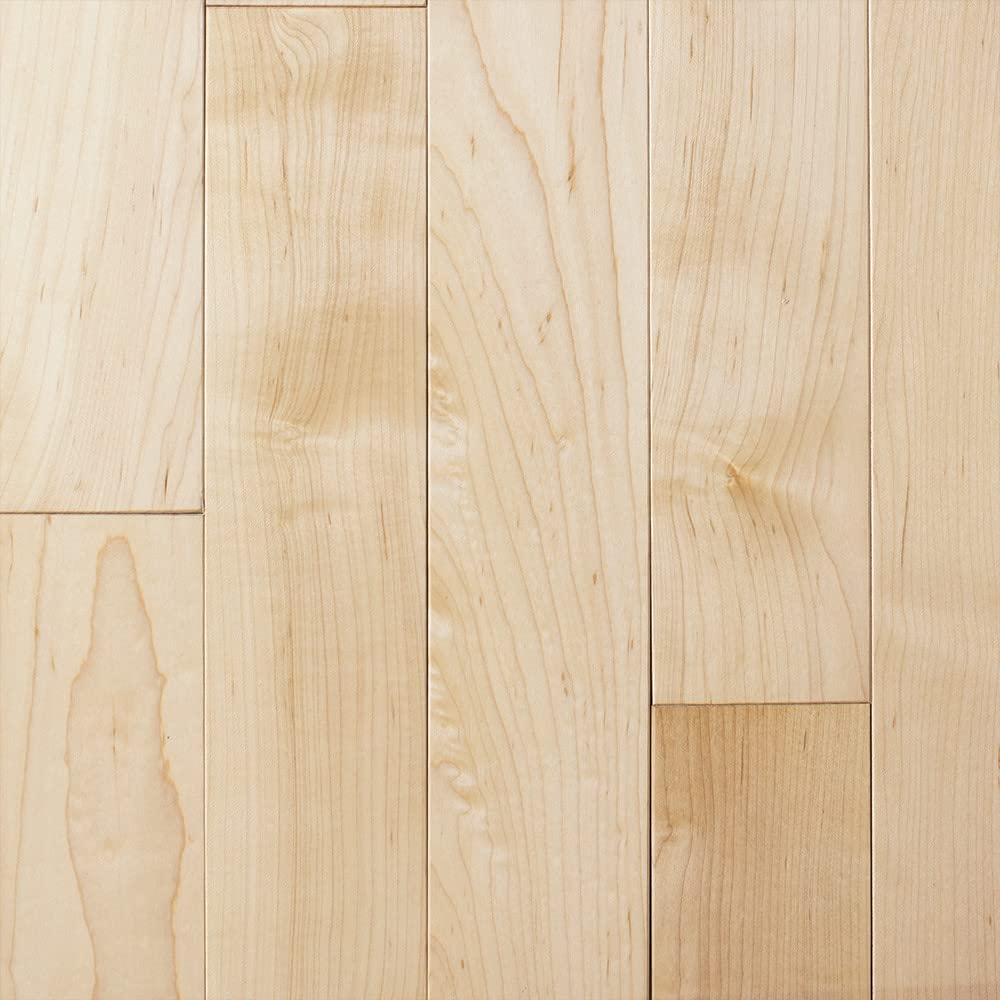
If you’ve been shopping maple flooring for more than a few hours, you’ve probably run into words like “Select,” “Character,” “Clear,” or “#1 Common” — and maybe assumed they were quality ratings, like grades on a test. They’re not, exactly. Hardwood flooring grades (the industry’s system for sorting boards by appearance) tell you what the wood looks like, not how hard or durable it is. A Character-grade maple floor is just as structurally sound as a Select-grade floor — it simply has more knots, mineral streaks, color variation, and visible grain drama. The catch is that those visual differences are dramatic, and they read very differently installed than they do on a website thumbnail. This guide will walk you through every major maple grade, what you’ll actually see on your floor, and — most importantly — how to make sure what you order is what you pictured.
Why Maple’s Grading System Catches People Off Guard
Most people buying flooring online build their mental image from a single product photo — typically a tight shot of three or four boards arranged under flattering studio lighting. That image is technically accurate. It’s also quietly misleading.
Maple is graded by the National Wood Flooring Association’s published standards (NWFA Technical Publication B100), and most major manufacturers — Lauzon, Mirage, Kahrs, and others — follow these conventions with minor brand-specific variations. The grades run roughly from “cleanest” to “most character-filled,” and the terminology shifts slightly by manufacturer. Here’s the practical translation:
Clear / Select & Better — The tightest, most uniform look. Boards are nearly all one color (creamy pale tan to white), minimal grain variation, very few or zero knots. If you want a Scandinavian-modern or clean contemporary look, this is your lane.
#1 Common (also called “Character” by many brands) — More color variation, some small tight knots, mineral streaks (those gray-blue or brownish lines caused by minerals in the soil), and visible grain contrast. This is the grade where maple starts to look like wood, not like a seamless laminate.
#2 Common (also called “Rustic” or “Natural”) — Open knots, significant color swings from board to board, heavy mineral streaking, and occasional small checks (tiny surface cracks). This is a dramatic, high-texture look. It can be stunning. It can also feel chaotic if it’s not what you planned for.
Character Grade (brand-specific) — Several brands — Lauzon and Mirage are the most prominent — use “Character” as a named grade that sits somewhere between #1 Common and #2 Common. Per Mirage’s 2024 product documentation, their Character grade explicitly includes mineral staining, color variation, and small knots but limits open defects. This is the grade that generates the most remorse calls. It reads richer and more textured than buyers expect when they see it at scale.
The NWFA’s consumer resource at woodfloors.org phrases it plainly: grades don’t describe quality, they describe character — meaning you’re choosing an aesthetic, not ranking your options from good to bad.
What Each Grade Actually Looks Like at Scale (A Room Full of It)
Here’s the core mistake: visualizing a grade from a product card rather than from an installed room. Maple’s color range is naturally narrow compared to oak or walnut, which means the within-board and board-to-board variation in character grades hits harder — you notice it more because the baseline is so pale and uniform.
Select & Better installed: The floor reads almost monolithic. Wide-plank Select maple from a supplier like Carlisle Wide Plank Floors at 5” or wider will show some subtle ray fleck and grain, but the overall impression is quiet and consistent. This is what people picture when they imagine a “light maple floor.” Under UV exposure over time, maple will yellow (more on that below) — and on a Select floor with minimal variation, that shift is very visible and even.
#1 Common / Character installed: The floor has rhythm. You’ll see 15–25% of boards with visible mineral streaking, clusters of small knots, and noticeable color variation from light cream to warm tan to occasional pinkish tones. This is often the “sweet spot” grade for buyers who want warmth without full rustic drama — but it surprises people who expected cleaner boards.
#2 Common / Rustic installed: High contrast. This is the grade that photographs beautifully on design blogs and then arrives looking much busier than expected. Open knots can be 3/8” to 3/4” across. Mineral streaks can run the full length of a board. If you’re building a farmhouse kitchen or a mountain cabin great room, this is intentional and gorgeous. In a 1,200-square-foot urban condo, it can feel overwhelming.
By the Numbers: Grade Mix Expectations
| Grade | Typical clear-board % in a box | Knot size range | Mineral streak frequency |
|---|---|---|---|
| Select & Better | ~85–95% | Rare, pinhead only | Very low |
| #1 Common / Character | ~50–70% | Tight, ≤3/8” | Moderate (15–25% of boards) |
| #2 Common / Rustic | ~25–45% | Open, up to 3/4” | High (40–60% of boards) |
These figures reflect typical manufacturer allowances documented in Lauzon’s 2025 product guide and are consistent with NWFA B100 ranges. Individual boxes will vary — which is precisely why ordering samples matters.
The Three Decisions That Prevent Grade Remorse
1. Order Samples and Photograph Them in Your Actual Light
This sounds obvious; almost nobody does it correctly. The mistake is looking at samples in the showroom or under your kitchen overhead light at noon, then installing the floor in a north-facing living room. Maple’s pale baseline means it shifts dramatically under warm incandescent versus cool LED versus natural north light. Character-grade mineral streaks that look subtle under warm light look stark and blue-gray under cool LED.
Order at least three samples per grade you’re considering. Tape them to your subfloor in the actual room, leave them for 48 hours, and photograph them at morning, midday, and evening. This Old House’s hardwood flooring guide makes exactly this point — they recommend evaluating samples at different times of day because wood reads differently under changing light.
2. Understand Maple’s UV Yellowing Against Your Grade Choice
Maple yellows under UV exposure — this is not a defect, it’s photochemical oxidation, and it affects every maple species regardless of finish. The critical thing: on Select & Better, the yellowing is uniform and visible as a floor-wide color shift. On Character and #2 Common grades, the yellowing interacts with the existing color variation, and the floor actually tends to look more harmonious over time as the variation blends. If UV yellowing worries you on a clean Select floor, this is a real argument for going up one grade toward more initial character.
The NWFA’s published guidance on wood oxidation confirms that lighter species including hard maple are most susceptible to photochemical color change, and that this is a species characteristic, not a finish failure.
3. Clarify Which Grade System Your Supplier Is Using
This is where experienced buyers get caught. A product listed as “Character Grade” by Lauzon and “Character Grade” by a generic BuildDirect product are not the same thing. Lauzon’s 2025 product guide defines their Character maple with specific allowances; a generic SKU may be using the label loosely. When you’re at the $6–12/sq ft tier or above, ask for the manufacturer’s specific grade description in writing before you order. If the supplier can’t produce it, that’s a yellow flag.
At the $12–30+/sq ft custom tier — wide-plank solid maple from Carlisle, custom-milled architectural grade — grading is often negotiated directly with the mill. You’re specifying allowable defect parameters, not picking a named bucket. If you’re at this level without a spec sheet, you’re flying blind.
The Maple-Specific Pitfall Nobody Warns You About: Blotchy Staining
If you’re buying unfinished maple to stain on-site, one more grade-specific issue deserves a full warning: maple is notoriously blotch-prone. Unlike oak, which has an open, porous grain that takes stain evenly, maple has a closed, tight grain that absorbs stain unevenly. The result — without a pre-conditioner or tinted base coat — is splotchy, uneven color that’s almost impossible to correct after the fact.
This problem is worse on Character and Rustic grades because the mineral streaks absorb stain at a completely different rate than the surrounding wood. What looked like attractive visual variation in natural maple can become a streaky mess in medium-brown stain.
If you’re planning to stain Character-grade maple: talk to your installer before you order, not after. Many experienced finishers recommend staying within the natural maple color range (clear finish, light white-wash, or very light tinted oil) and treating the character variation as the design feature — not a canvas to be covered. Architectural Digest’s coverage of designer hardwood selections consistently features maple in its natural or lightly-whitened state precisely for this reason.
The Decision Rule: If X, Then Y
If you want a clean, contemporary, low-visual-noise floor and your room gets strong direct sun: → Select & Better, prefinished or site-finished with UV-inhibiting aluminum oxide topcoat. Accept that it will yellow over years and plan for it.
If you want warmth and texture but are ordering online without an in-person showroom visit: → Order samples of both #1 Common and Character grade from your specific manufacturer. Do not commit at scale without the 48-hour light test described above.
If you love the look of heavily grained, knotty wood you’ve seen on design blogs: → Order a full sample box of #2 Common / Rustic before finalizing. The single-tile photo does not prepare you for the installed effect.
If you’re specifying for a client or a volume project and you can’t afford grade remorse after delivery: → Get the manufacturer’s written grade specification, not just the marketing grade name. Lauzon and Mirage both publish these; hold every supplier to the same standard.
If you’re planning to stain maple darker than its natural tone: → Switch species, or consult your finisher before you order a single board. Maple and dark stain is a technical challenge that many installers will discourage outright.
The grade system isn’t complicated once you see it as an aesthetic filter rather than a quality ranking. The remorse comes from misaligned expectations — from trusting a product photo instead of a sample in your actual space. Get the samples, run the light test, ask for the spec sheet. Your floor will be there for twenty years. The homework is worth the afternoon.