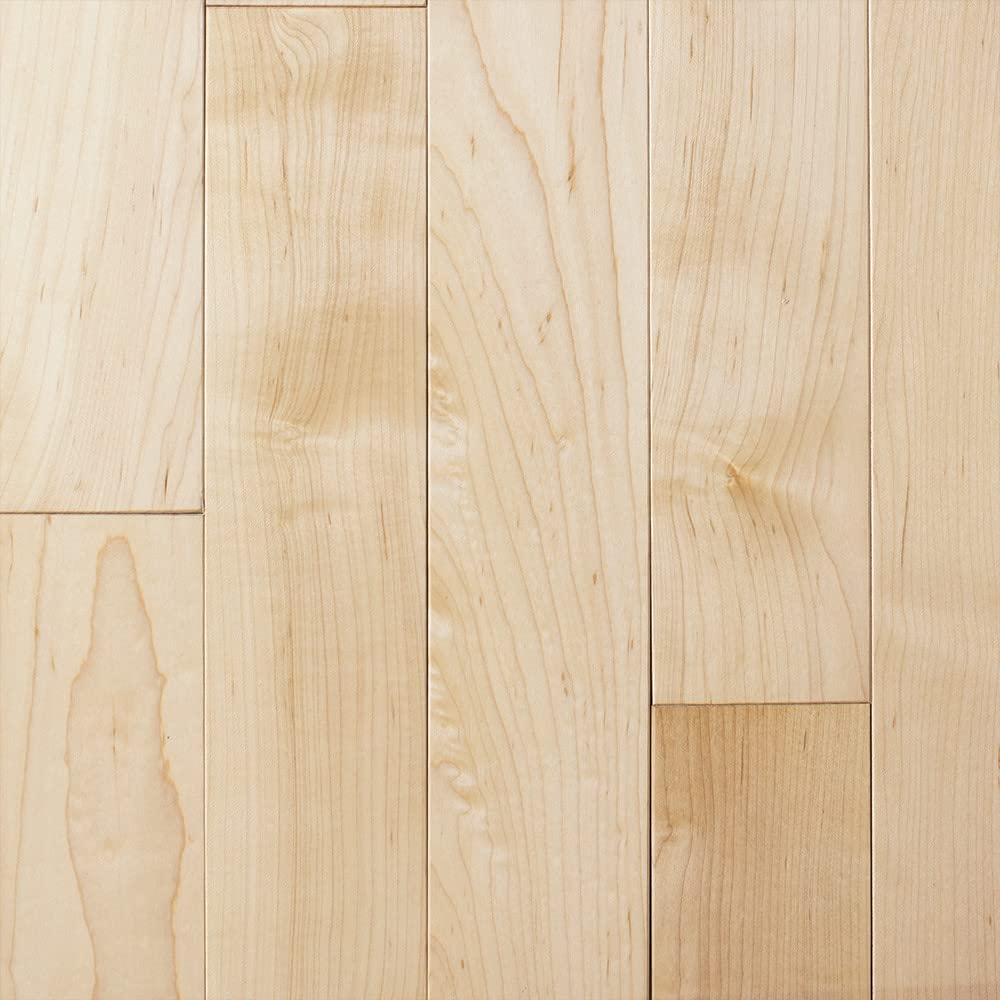
If you’ve been staring at flooring quotes wondering why two bids for “maple hardwood” are $4,000 apart, you’re not imagining it — the gap is real, and it’s almost never the maple itself that explains it. Solid maple hardwood flooring means boards milled from actual maple trees (as opposed to engineered flooring, which is a thin maple veneer glued over a plywood core). Solid maple is thicker, can be sanded and refinished multiple times over decades, and is widely considered a long-term architectural investment. The catch: the material price on the invoice is only one slice of what you’ll actually spend. Labor, subfloor prep, moisture management, and finish choices can quietly double your project cost — and with maple specifically, a few biological quirks make those line items matter more than they do with, say, oak. This guide breaks down every number, names the surprises, and ends with a clear decision rule so you know exactly when solid maple makes sense and when to walk away.
The Real Cost Breakdown: Material vs. Everything Else
Let’s start with what the market actually looks like in mid-2026.
By the numbers — solid maple flooring, installed:
| Tier | Material (per sq ft) | Installed total (per sq ft) | Typical project sweet spot |
|---|---|---|---|
| Mid-range solid (Lumber Liquidators, Lauzon) | $6–$12 | $10–$18 | 500–1,200 sq ft, existing slab/subfloor |
| Premium/custom wide-plank (Carlisle, custom mill) | $12–$30+ | $20–$45+ | Custom homes, design-build whole floors |
| Budget solid (clearance, builder-grade) | $3–$6 | $8–$13 | Rentals, flips — not recommended for long-term |
Per This Old House’s editorial cost guide, hardwood installation labor runs $3–$8 per square foot nationally, with maple often landing at the higher end because the wood is harder to nail and more demanding to sand evenly. The NWFA’s installation guidelines flag maple’s tight grain and density as a factor that slows installation and increases blade and sandpaper consumption — both of which installers pass back to you.
So when you see a quote for $14/sq ft installed on a 900-square-foot open-plan, the math probably looks like this:
- Material: ~$8/sq ft × 900 sq ft = $7,200
- Labor (install): ~$4.50/sq ft × 900 sq ft = $4,050
- Sand and finish (if unfinished boards): ~$2.50/sq ft = $2,250
- Subfloor prep, transitions, disposal: $500–$1,500
Total realistic range: $14,000–$16,000 — for a project that a line-item estimate might have made look like $10,800. That gap lives in the hidden rows.
Where the Surprises Actually Hide
Subfloor Prep Is the Iceberg
Maple has almost zero tolerance for subfloor movement. The NWFA’s installation standards require subfloors to be flat within 3/16 of an inch over a 10-foot span before solid hardwood goes down. With oak, experienced installers sometimes flex this. With maple, flex it and you get cupping (boards bowing along their width), gaps, or squeaks within the first heating season.
If your subfloor needs grinding, shimming, or self-leveling compound, budget $1–$4 per square foot on top of everything else. A 1,000-square-foot job that needs light leveling can add $1,500–$3,500 before a single maple board is touched. Contractors should be pulling this number out during the site visit — if they’re not, ask directly: “What’s your call on the subfloor, and how is that priced?”
Moisture Management Costs Real Money
Maple is more dimensionally reactive to moisture changes than red oak. Fine Homebuilding’s installation archive notes that solid maple should acclimate on-site for a minimum of 5–7 days before installation, and some custom installers run 10–14 days for wide-plank stock in humid climates. That acclimation time isn’t free — it extends the job timeline, which affects your contractor’s scheduling and, sometimes, their price.
More importantly: if your slab or crawlspace has any moisture ambiguity, you need a membrane or vapor retarder, which adds $0.50–$1.50/sq ft. Skip it and you’re gambling on a $15,000 floor.
Grade and Species Are Not the Same Thing
Here’s a detail that trips up even experienced buyers: “maple” on a quote doesn’t tell you whether you’re getting hard maple (Acer saccharum, Janka hardness ~1,450) or soft maple (several species including Acer rubrum, Janka ~950). Wood Flooring Business’s species report notes that soft maple is sometimes sold as maple flooring without explicit labeling, particularly in the lower price tiers.
Hard maple costs more and is genuinely more durable under foot traffic — it’s the species used in NBA basketball courts. Soft maple is closer to cherry in hardness and dents more readily. If a quote seems suspiciously low, ask the rep to confirm the species by botanical name.
Grade matters too: Select and Better maple shows near-uniform color and minimal knots; Character Grade (also called Rustic or #2 Common) shows heavy mineral streaks, knots, and color variation. Character grade from Lauzon or Mirage is increasingly popular as a design choice, but it will cost 20–30% less per board than Select — so if your quote is mixing grades, make sure you know which you’re getting.
Finishing: Pre-Finished vs. Site-Finished Changes Your Budget and Your Life
Pre-finished solid maple (Mirage and Lauzon both carry strong lines here) leaves the factory with UV-cured aluminum-oxide finish already applied. It installs faster, you can move furniture back in two days, and the factory finish is generally harder than anything applied on-site. Budget for pre-finished boards in the $8–$14/sq ft range for mid-tier.
Site-finished (unfinished boards sanded and coated on-site) gives you full control over sheen level and color, lets a skilled installer feather transitions perfectly, and is the only route for some custom-milled wide-plank stock. But add $2–$4/sq ft for the sand-and-finish labor, plus 3–5 days of no-occupancy while coats cure. Homeowners on Houzz community discussions consistently flag this as an underestimated disruption — particularly in whole-home renovations where you’re already displaced.
One more maple-specific flag on finishing: maple blotches badly with penetrating stains. Its tight, uniform grain resists even dye absorption, producing splotchy, uneven color. If you want a stained maple floor and you’re not working with an installer who has done it before with a pre-conditioner and grain-filler step, you will likely be disappointed. The safer path is natural/clear finish or a light wire-brush texture (which opens the grain slightly and accepts color more evenly). This is one of maple’s real-world weaknesses, and it’s worth naming before you fall in love with a walnut-stained sample.
UV Yellowing: The Long-Term Cost Nobody Quotes
This is the pitfall that surprises homeowners five years after installation, not five months. Maple contains high levels of a compound that reacts to ultraviolet light, causing the wood to yellow — sometimes dramatically — over time. Per aggregated owner feedback on Houzz and Fine Homebuilding reader forums, maple floors in south-facing rooms with significant sun exposure can shift from pale cream to a warm amber-gold within 3–5 years.
This isn’t a defect. It’s the biology of the species. But it has real budget implications:
- Area rugs create sharp contrast lines where sun-exposed and protected sections age differently.
- If you refinish a maple floor 10 years in, the sanded surface will be lighter than the aged surrounding boards until it catches up — which can take a year or more.
- Window film or UV-blocking treatments ($2–$6/sq ft on glass) can slow but not stop the process.
Factor UV mitigation into the total project budget if you’re in a sun-heavy space, and have a direct conversation with your designer or installer about placement before you commit.
The Contractor Conversation You Need to Have
If you’re currently negotiating a quote, here’s the specific list of line items to confirm in writing before signing:
- Species and grade — hard maple or soft maple, botanical name, grade classification
- Subfloor prep included or excluded — and what the per-square-foot rate is if additional work is needed
- Moisture testing — who does it, when, and what the threshold is for adding a membrane
- Acclimation time — built into the schedule or not
- Finish type — pre-finished (factory) or site-finished; if site-finished, number of coats and product name
- Staining — who has done it on maple before — ask for a photo of a completed maple stain job before approving
Contractors who can’t answer items 1–4 clearly are not necessarily incompetent, but they may be pricing you a floor-only bid while leaving subfloor and moisture unknowns off the invoice. That’s where the $3,000–$5,000 surprises come from.
The Decision Rule
Here’s the if/then framework based on where your project actually sits:
If you want a light, Scandinavian-palette floor with a natural finish, in a space with moderate foot traffic and no heavy sun exposure: solid hard maple in Select or Better grade, pre-finished, is an excellent choice. Budget $12–$18/sq ft installed at the mid-range tier.
If you’re building or renovating a high-design custom space and want character, texture, or a design-forward floor: look at Lauzon or Mirage wire-brushed character-grade maple, site-finished with a clear or lightly tinted oil. Budget $18–$30+ installed. Have your designer or the mill confirm the finish system handles the grain-opening you want.
If your goal is a dark-stained or heavily colored floor: maple is the wrong species. Oak, hickory, or walnut will take stain predictably. Forcing maple into a stain application is one of the most common expensive regrets in this category.
If the space gets heavy direct sun most of the day: either choose a species that ages more gracefully under UV (white oak is the most common alternative), or budget for UV-blocking window film and understand the floor will change color meaningfully over time.
The pricing in this category is honest if you read the full invoice. The surprises aren’t hidden by contractors trying to deceive you — they’re hidden by a quoting process that separates “the floor” from “everything that makes the floor work.” Your job now is to close that gap before you sign.
Ready to compare species side by side or calculate your actual project square footage including waste factor? Use the comparison tool and cost calculator above to build your project estimate before you request bids.